

Insider Espionage and Encryption: A Simulated Case Study of ABC Corp
Disclosure: This is a hypothetical case study written for illustration. ABC Corporation is fictional, and the incident described is a simulated scenario, not a real breach, though the lessons-learned are extremely valuable.
When data walks out the door, the attacker may already have a badge. This case study looks at a fictional electronics giant that lost its intellectual property and financial data, and at the policy, access, and encryption controls that could have made the theft useless.
Introduction
What follows is a case study concerning the targeted cyber attacks against, and data theft from, ABC Corporation, a hypothetical organization. In this case study, ABC Corp is a multinational consumer electronics firm with thousands of employees and devices, dispersed across multiple locations around the world. Recently, ABC Corporation experienced a series of cyberattacks aimed at its network infrastructure, which led to the theft of intellectual property and financial data. The purpose of this case study is to examine this attack using the few details known about the scenario, through the lens of corporate espionage and encryption, as the nature of the stolen data suggests insider access may have played a significant role.
Possible Vulnerabilities
ABC Corporation most likely suffers from a combination of security issues including policy enforcement, policy blind spots, improper access controls, and lack of data encryption. Currently, sufficient background checks on new employees and exit procedures are not performed. Security awareness training is minimal and lacks modules for corporate espionage awareness. There is also a general inconsistency of policy and enforcement across global offices.
Considering these higher-level issues, the organization is particularly vulnerable to corporate espionage or standard insider threats. These threats can involve disgruntled or departing employees who manage to exfiltrate data, ranging from low-tech ways such as portable media or social engineering, to tech-enabled threats that have the ability to plant spyware, malware, or malicious devices within the organization to steal data or maintain remote access.
Importance of Network Security
Network security is important for any organization; however, for those institutions handling sensitive information, the importance of proper security measures cannot be overstated. Organizations are not only responsible to guard the sensitive data of third parties in their possession, they must also guard their own intellectual property, because such data has real-world value. In Easttom's Computer Security Fundamentals, the value of information (VI) is quantified as the cost to produce (C) plus the value gained (VG), ergo VI = C + VG.
Because information is of real value to the organization that holds it, network security and proper information security are key to protecting informational assets and data. This is why the need for strong policy and enforcement, access controls, monitoring, and encryption of data is critical in the current business climate. The FBI's 2019 report on the risk to corporate America puts the annual cost to the U.S. economy of counterfeit goods, pirated software, and theft of trade secrets between $225 billion and $600 billion. With this in mind, it is more important than ever that organizations take a serious stance on network and information security, implementing a multi-layered approach with proper policy, implementation, and continuous review and improvement.
Analysis of Existing Practices and Improvements
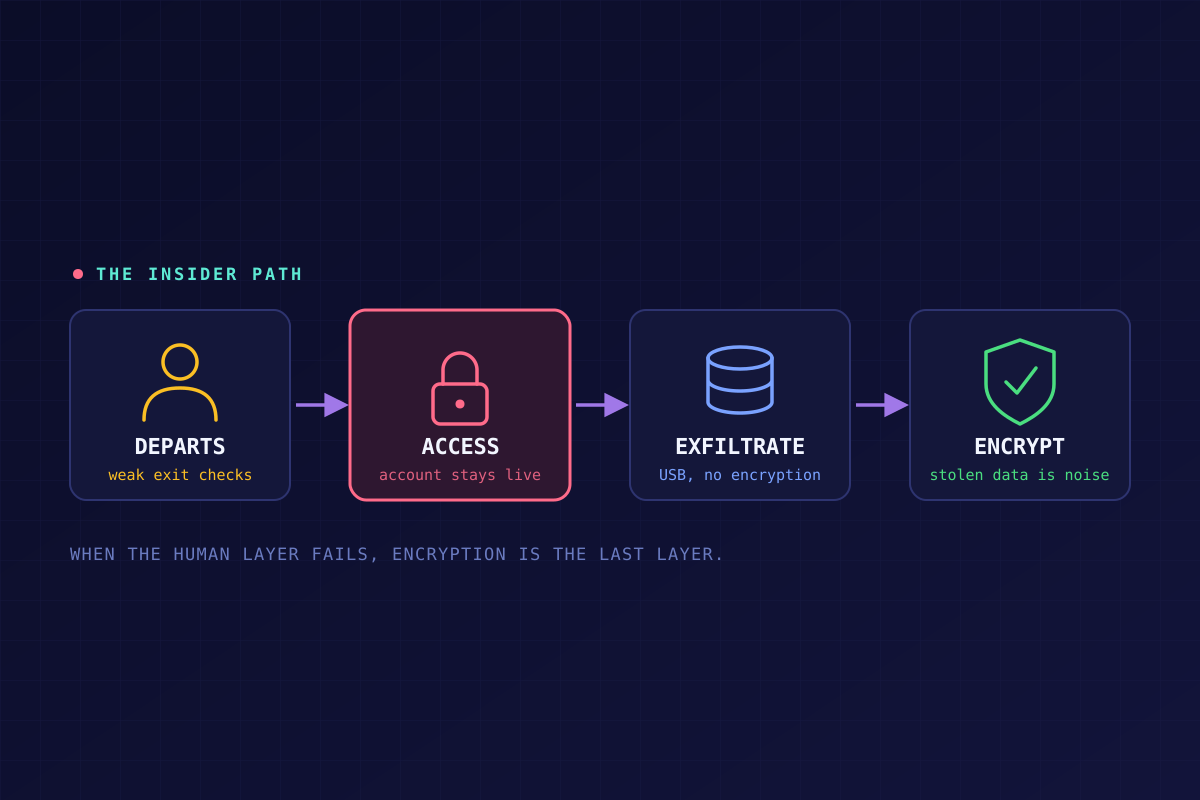
ABC Corp currently has weak policy regarding portable device security like USB and portable drives. Additionally, employee background policy has not been standardized across the organization due to the legal challenges of operating in multiple countries with different standards for record-keeping and background inquiries. Exit policy has also been inconsistently adhered to, as an audit found one foreign location often waited several weeks to deactivate terminated employee access accounts. Physical access controls are inconsistent across the organization as well, and virtual access controls are generally left to the discretion of the local network administrators.
Improvements involve policy standardization across the company, as well as strict enforcement. Without this change at the top, any other recommendations will ultimately fail. ABC Corp must establish a baseline for background-check standards that meets the strictest requirement allowed by local jurisdiction. They must also implement a zero-trust architecture that requires authentication for all access to critical data, at all levels. Within this system, access must only be granted on a need-to-know basis. Improvements to physical access should also be made, only allowing employees access to sensitive areas on an as-needed basis. Additionally, regular audits must be performed against all access controls to ensure effectiveness.
Portable storage devices must also be tightly controlled. Policy must be written and enforced, strictly controlling their use. The restriction of USB devices can usually be enabled at the BIOS level of computer systems, or through endpoint management policy. These restrictions should be on by default and only removed by the administrator on an as-needed basis. Also, employees should be restricted from bringing their own USB devices on premises, including charging cables and power blocks. All approved BYOD devices should be scanned for company data upon exit, per policy. Lastly, endpoint detection and log monitoring for data access, portable device mounts, and unusual data movement should be installed on system hosts.
Cryptography
Because security is a multi-level approach, controls must be implemented in a way that presents barriers in separate layers to prevent attacks. Should one control fail, the hope is the next control will succeed. No single-point data security failure should be acceptable. Following this principle, underneath all of the policy changes, access controls, and monitoring should lie a layer of encrypted data that prevents stolen data (should it occur) from being useful. ABC Corp should encrypt its data at rest, like databases, critical files, portable drives (if allowed), and endpoint storage, with AES-256 encryption. Keys should be managed using a secrets management solution so that even if databases or application servers are compromised, attackers cannot recover usable encryption keys.
Data in transit should traverse the network, VPN, and WAN using HTTPS with TLS 1.3. TLS 1.3 only allows modern authenticated (AEAD) ciphers, such as AES-256 or AES-128 in GCM mode, or ChaCha20-Poly1305, which provide both confidentiality and data integrity. Within this system, asymmetric cryptography handles the key exchange (ephemeral Diffie-Hellman in TLS 1.3, which also gives forward secrecy) so that both sides can agree on the symmetric keys that protect the data flow.
Lastly, while chapter 8 of the book discusses credential hashing using algorithms like MD5 and SHA, standards are changing. OWASP recommends that credentials be salted (even peppered) and hashed with the Argon2id algorithm. Argon2id has three configurable parameters (memory, iterations, and parallelism) that, in simple terms, make it computationally expensive to compute, and even more expensive to crack. Fast hashes like SHA-256 are a poor fit for passwords because they let attackers make huge numbers of guesses quickly, especially on modern GPUs. A note on rainbow tables: those precomputed lookup tables are defeated by unique per-user salts, while a slow algorithm like Argon2id is what blunts brute-force guessing.
Additional Security Measures
Along with other controls mentioned, MFA plays a key role as a general best practice for authentication. Regular security awareness training and corporate espionage awareness should also be implemented, along with a program to monitor insider threats using data-loss prevention tools and behavioral analytics. Additionally, incident response plans regarding network attacks and insider threats should be developed, along with periodic auditing of policy and implementation across all global sites. Finally, penetration testing, specifically simulating insider threats, can reveal additional weaknesses before they are exploited.
Conclusion
To summarize, the likely root cause of ABC Corporation's data breach was an insider-driven espionage incident compounded by a lack of encryption of sensitive data. By implementing strict access control policy, data-loss prevention controls, and strong encryption, the organization can lower the risk of a similar incident in the future.
The Takeaway
Notice how little of ABC Corp's problem is exotic. A departing employee whose account stays alive for weeks, a USB port nobody restricted, and a database nobody encrypted. None of those need a zero-day. Each control in this study is a layer, and the point of layers is that when the human one fails (and sooner or later it will), encryption is what turns a stolen file into unreadable noise.
Sources
- Easttom, C. (2023). Computer Security Fundamentals (5th ed.). Pearson.
- Federal Bureau of Investigation. (2019). China: The Risk to Corporate America.
- OWASP. Password Storage Cheat Sheet. OWASP Cheat Sheet Series.
- Rescorla, E. (2018). RFC 8446: The Transport Layer Security (TLS) Protocol Version 1.3. IETF.
- Encryption Consulting. (2025, May 19). A Comprehensive Guide to TLS Encryption.