

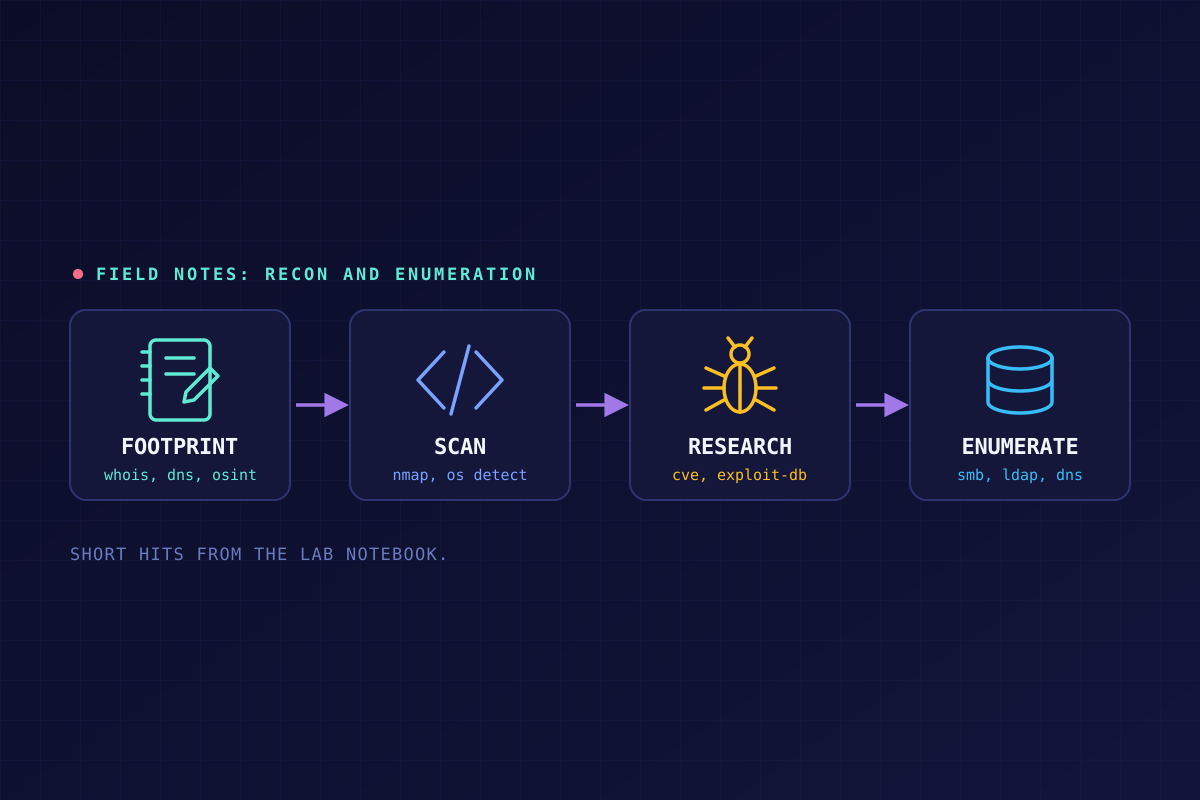
Field Notes: What Enumeration Actually Looks Like
Once you're inside a network, you're basically blind until you enumerate it. Here's the toolkit, service by service.
Getting onto a network and actually understanding it are two different problems. Enumeration is the process that closes that gap: building a working picture of the hosts, operating systems, services, and user accounts actually present, so you can plan a next move instead of guessing one.
Beyond unpatched CVEs, enumerating and exploiting network services themselves is one of the most reliable ways to move through a system or reach user accounts and data. There's a dedicated tool for nearly every protocol, and nmap carries scripts for most of them too:
- NetBIOS —
nmblookup,nbtscan, or nmap's SMB scripts, for hostnames and shared resources. - SNMP —
snmpwalk, to pull configuration data and system information. - LDAP —
ldapsearchor nmap, which can reveal user accounts and directory structure. - NTP —
ntpqor nmap'sntp-infoscript, to surface server details and misconfiguration. - NFS —
showmountandrpcinfo, to find exposed file shares. - SMTP — nmap's
smtp-user-enumscript, or a manual Telnet connection. - DNS —
dig,nslookup,dnsenum, ordnsrecon, to map domain structure and subdomains.
Mitigations. A full protocol-by-protocol mitigation list would run long, but the generalities hold up well: disable any service that isn't actually needed, tighten firewall rules and access controls, and segment the network so devices only reach what they actually need to share. Keep software current and apply patches promptly. Monitor continuously, audit regularly, and run security testing against your own environment before someone else does it for you. In short — the best mitigation here is the same one that shows up everywhere else in security: stick to the recognized best practices, consistently.
The Takeaway
Enumeration isn't glamorous. It's patient, protocol-by-protocol legwork — and it's also exactly where most networks give up more than they realize, because half of these services are still running, unneeded, with default configurations nobody's looked at in years.