

Your Smart TV Is Watching You Back
Earlier this year, GamersNexus — a tech outlet usually known for hardware reviews, not security investigations — put out a two-hour deep dive into LG smart TVs that's hard to overstate. The short version, since corroborated by other outlets covering the same findings: LG's TVs are collecting a lot more than anyone signed up for.
What they actually found
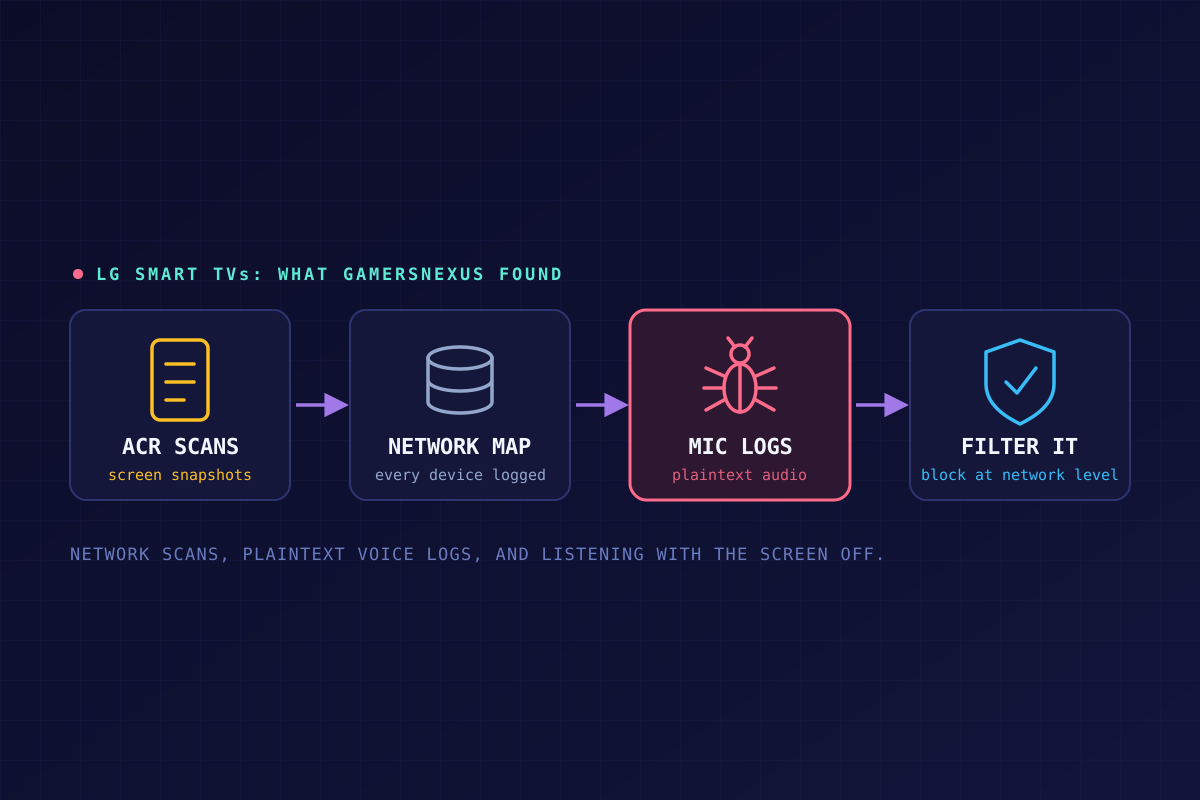
- Automatic Content Recognition (ACR): the TV takes periodic snapshots of whatever's on screen and runs them through AI to identify content, which then feeds targeted advertising. LG doesn't really hide this part — it's a known "feature" — but the scale and persistence of it is more aggressive than most people realize.
- Network scanning: the TV actively sweeps your local network and catalogs every other device on it — internal IP addresses, device names, MAC addresses, even nearby WiFi network names — and that data gets tied back into the same advertising pipeline, so LG and its ad partners can target ads to your phone based on what your TV sees on your network.
- Microphone data: this is the part that should bother everyone. Testing showed the TV and its remote capturing clean, intelligible audio — including, in testing, picking up speech for 10 to 15 seconds after someone stopped talking — and storing plaintext, unencrypted transcriptions in on-device logs. Disconnecting the TV from the network didn't stop the recording; it just queued the captured audio locally until the TV reconnected and uploaded it.
- It's hackable, too: because the TV is a Linux box at heart, running LG's webOS, GamersNexus found remote-code-execution flaws in its network-facing services and demonstrated turning a compromised TV into a listening device that kept capturing room audio with the screen off and the Ethernet cable unplugged.
LG's response was the predictable one: it denies that voice processing happens outside of an explicit wake-word or remote-button press, and says ambient audio gets deleted immediately if no wake word is detected. GamersNexus's testing says otherwise. I'll let you decide who to believe, but I know which direction the data points.
Why I actually care about this one
Privacy...
I run network-wide DNS filtering at home, and after turning it on I was honestly shocked by the numbers. On an average day right now, close to 96,000 DNS queries leave my network, and roughly 20,000 of those get blocked outright — not because I'm visiting shady sites, just from the normal background noise of every "smart" device on the network phoning home to something I never asked it to talk to. A smart TV is one device among many doing this, but it's one of the worst offenders, because it sits in the living room with a camera-adjacent microphone, a persistent network connection, and most people's full trust.
That's really the point here: browser-level privacy settings matter, but they only cover browser traffic. A TV, a doorbell camera, a smart thermostat — none of that goes through a browser, and none of it is touched by browser-level protections. If you actually want to control what leaves your network, you have to filter at the network level, not the app level.
Takeaway
The uncomfortable part isn't just that LG's TVs are doing this in people's living rooms — it's where else these TVs end up. They're built in China and installed in lobbies, meeting rooms, waiting areas, and conference rooms across businesses, hospitals, and government buildings worldwide, usually with nobody treating them as the networked, microphone-equipped, Linux-powered device they actually are. If a TV can map every other device on a home network and quietly listen after "off," it deserves the same scrutiny as any other endpoint you'd never leave unmanaged on a corporate network. Right now, almost nobody's giving it that scrutiny.