

Not Exotic, Just Ordinary: Five Breaches and the Boring Failures Behind Them
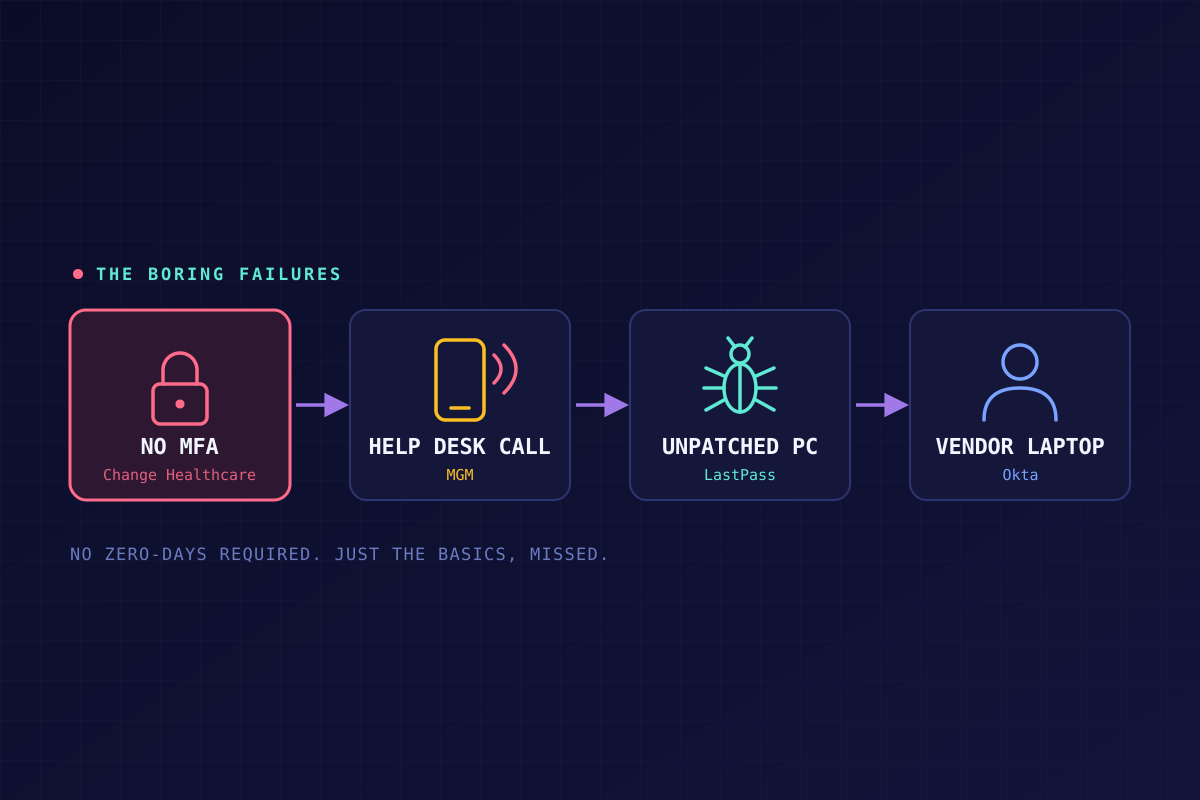
Four of these five breaches didn't need a clever exploit. They needed a stolen password, a convincing phone call, an unpatched home PC, or a vendor's laptop.
Introduction
The purpose of this report is to review five recent organizational network security breach incidents in order to catalog the affected organization, data compromise, exploited vulnerability, potential preventative measures, and document a source reference. Additionally, the incidents will be reviewed to highlight similarities and differences between them, and to analyze the potential impact of proposed solutions and mitigation.
Incidents
Change Healthcare
| Incident date | Initial access 12 February 2024; ransomware deployed and disclosed 21 February 2024 |
| Affected organization | Change Healthcare (UnitedHealth Group) |
| What was taken? | Ransomware and data theft affecting an estimated 190 million people. UnitedHealth's CEO told Congress the company paid a ransom, and Wired reported $22 million in Bitcoin to a wallet tied to the BlackCat/ALPHV group. |
| Exploits used | When I wrote this report, the entry method hadn't been disclosed, and I speculated about RDP exploits or an Active Directory brute-force attack. It was later confirmed in the CEO's May 2024 testimony: attackers used compromised credentials on a Citrix remote access portal that had no multifactor authentication. |
| Preventative measures | MFA on every remote access path, plus the hardening of Active Directory I originally suggested |
| Reference source | Kerner, TechTarget |
MOVEit
| Incident date | Exploitation began about 27 May 2023; the vendor patched on 31 May |
| Affected organization | Progress Software's MOVEit Transfer, a multi-victim supply-chain incident |
| What was taken? | Sensitive files in transit, including personal and financial data. As of 1 January 2024, more than 2,700 organizations and roughly 93 million individuals were affected, most of them indirectly through third-party vendors. |
| Exploits used | Zero-day SQL injection vulnerability (CVE-2023-34362), exploited by the CL0P ransomware gang |
| Preventative measures | Increase all preventative measures: access controls, MFA everywhere, automated patching, network segmentation, increased vulnerability scanning, assessment, mitigation, and validation |
| Reference source | CISA Advisory AA23-158A |
MGM
| Incident date | 11 September 2023 |
| Affected organization | MGM Resorts |
| What was taken? | Customer personal information from before March 2019, including names, contact details, driver's license, Social Security, and passport numbers. Impact was roughly $100 million in lost earnings, plus ransomware that took down 100+ ESXi hypervisors. |
| Exploits used | Social engineering followed by ransomware. Attackers reportedly called the IT help desk, posing as an employee, and got a password reset, eventually reaching super-administrator rights in Okta and Global Administrator in Azure. The attackers were the ALPHV/Scattered Spider group. |
| Preventative measures | User education and stronger caller authentication (such as callbacks), plus device trust and tighter control of administrator accounts |
| Reference source | Netwrix |
LastPass
| Incident date | Two linked intrusions, August to October 2022. LastPass published the full findings on 1 March 2023. |
| Affected organization | LastPass |
| What was taken? | Source code, DevOps secrets, the MFA/federation database, and backups of customer password vaults. The vaults were encrypted, but metadata such as website URLs was not. |
| Exploits used | A senior DevOps engineer's home computer was compromised through an outdated Plex Media Server (CVE-2020-5741), and a keylogger was used to capture the credentials needed to reach the corporate vault of keys. |
| Preventative measures | Policy enhancement, employee education, and no corporate keys or secrets on personal devices |
| Reference source | UpGuard |
Okta
| Incident date | 16 to 21 January 2022 (Okta was alerted 20 January). The public learned of it on 22 March 2022. |
| Affected organization | Okta, through its third-party support vendor Sitel |
| What was taken? | Limited. About 366 customers (roughly 2.5%) had tenants accessed by Sitel staff during the window. |
| Exploits used | An attacker gained remote desktop (RDP) access to a Sitel support engineer's computer. The exact initial vector was not publicly confirmed. |
| Preventative measures | Enhanced third-party vulnerability assessment and user education |
| Reference source | Bradbury, Okta |
Comparative Analysis
Examining both the similarities and differences in each case can provide insight into how such incidents occur, and how effective responses and mitigation efforts were. Most incidents listed here could possibly have been prevented through more strenuous risk assessment and vulnerability analysis, with the exception of the MOVEit breach, which occurred through the use of a 0-day exploit. Most mitigation against 0-day exploits within current security methodology revolves around detection and not necessarily predictive efforts to hunt undiscovered exploits within an organization's network. Guarding against unknown exploits may simply come down to being prepared to detect them as quickly as possible, and having systems in place such as firewall rules that make data theft difficult for malicious actors.
Each of the four remaining incidents displays commonality in obvious failures at some level. When I first wrote this report, it was interesting to note that in some cases the exact exploit remained unknown. I speculated that Change Healthcare may have fallen to an undisclosed 0-day, as MOVEit did. That turned out to be wrong, and in a more sobering way: no zero-day was needed. Stolen credentials and a portal without MFA were enough.
Considering both Change Healthcare and MGM were victims of ransomware, only Change Healthcare is reported to have paid. MGM refused to pay and absorbed tens of millions in losses over more than ten days of downtime, while its competitor Caesars, hit by the same group, paid $15 million. The reasons behind those decisions may always be private, but it would be interesting to know the factors that play into whether or not an organization decides to pay a ransom. The ethical concerns surrounding ransomware payments are fascinating.
Two cases stand out among the rest, for different reasons. The Okta breach was unique in that it suffered a very standard third-party exposure, yet its impact stayed small by modern standards. Okta says its support engineers worked through a least-privilege tool that could not create or delete users, download customer databases, or reach source code, and its security team suspended the compromised account within about an hour of the alert. Particularly impressive is the statement issued by Okta's CSO, David Bradbury, detailing the attack and mitigation efforts while striking a tone between reassuring and apologetic. It's worth noting the timing, though. Okta contained the account in January, but the public heard about it in March, after the LAPSUS$ group posted screenshots. Bradbury himself wrote that he was "greatly disappointed by the long period of time" between notifying Sitel and getting the complete investigation report. Okta's transparency was good once it came, but it came late.
Okta's efforts contrast sharply with the LastPass breach noted in the data, which unfolded over several months as a pair of linked incidents snowballed into an embarrassing episode. In August 2022, attackers stole source code from LastPass's development environment. Each step became a steppingstone towards the goal of getting the keys to LastPass's cloud storage.
One of only four DevOps engineers with access to those keys ran a Plex media server at home, on a computer that also held corporate credentials. Plex later confirmed that the flaw used had been patched in May 2020, and that the engineer never updated. Attackers used it to install a keylogger and reached the vault of corporate keys, then copied customer vault backups. Those vaults were encrypted with each user's master password, so their safety came down to how strong each master password was. That protection was not absolute. By September 2023, researchers had linked thefts of more than $35 million in cryptocurrency from 150+ victims to cracked vaults, and the UK's data protection regulator later fined LastPass for failing to secure its systems, citing among other things senior staff using business accounts from personal devices. It is a unique case, and a reminder to both organizations and employees that passwords and encryption keys should never be stored on unprotected personal devices or home networks.
One final issue to address here is the prevalence of social engineering and spear-phishing campaigns. In the MGM attack, attackers reportedly picked out an employee on LinkedIn and impersonated them to the IT help desk by phone. This is an all-too-common occurrence. Such incidents were also factors in the famous 2020 Twitter account hacking attack, where Twitter said attackers used a phone spear-phishing attack against employees, and in Google's August 2025 breach, where attackers reached a Salesforce database. How can these attacks be prevented? Access controls and authentication have come a long way, with authenticator apps and phishing-resistant methods like passkeys. Can the problem organizations face by impersonation and social engineering via phone and email be solved? What if, for example, a help desk employee could push a text message to the phone of the named employee seeking assistance with a one-time code, to be read back over the phone? In any event, user education and social engineering resistance training can go a long way towards countering these types of attacks.
Conclusion
In most every case discussed here, it would seem that more robust vulnerability and risk assessment could have possibly prevented the attacks. Proactive defense must never rest. Processes to identify weaknesses in both the technical and human aspects of network security must be honed, implemented and ongoing, along with constant development of mitigation strategies and training.
The Takeaway
Line the five up and a pattern shows. Change Healthcare was a missing MFA prompt. MGM was a help desk that believed a caller. LastPass was an unpatched media server on an engineer's home PC. Okta was a vendor's laptop. Only MOVEit was a true software zero-day. The expensive part of each breach was something ordinary: an identity, a person, a process, or a patch nobody applied. Defense doesn't have to be exotic to be effective, but it does have to be boring and consistent, every day, everywhere.
Sources
- Kerner, S. (2024, March 8). The Change Healthcare attack: Explaining how it happened. TechTarget.
- Change Healthcare breached via Citrix portal with no MFA. TechTarget.
- Change Healthcare discloses USD 22M ransomware payment. IBM Think.
- CISA. (2023, June 7). #StopRansomware: CL0P Ransomware Gang Exploits CVE-2023-34362 MOVEit Vulnerability.
- Progress Software's MOVEit meltdown: uncovering the fallout. Cybersecurity Dive.
- Schrader, D. (2025, February 14). An Overview of the MGM Cyber Attack. Netwrix.
- MGM Resorts ransomware attack led to $100 million loss, data theft. BleepingComputer.
- What everyone got wrong about the MGM hack. 1Password.
- MGM, Caesars Cyberattack Responses Required Brutal Choices. Dark Reading.
- Kost, E. (2025, January 5). The LastPass Data Breach (Event Timeline And Key Lessons). UpGuard.
- LastPass engineer's failure to update Plex software led to massive data breach. The Hacker News.
- LastPass 2022 data breach. Wikipedia.
- Bradbury, D. (2022, March 24). Okta's Investigation of the January 2022 Compromise. Okta.
- Twitter. (2020, July 30). An update on our security incident.
- Google discloses data breach via Salesforce hack. SecurityWeek.