

Field Notes: What "Computer Network Defense" Actually Means
CND has the flavor of a government term because that's exactly what it is. The phrase came out of the defense and government sectors back in the late '90s and early 2000s, and you can still tell — search the term today and you'll mostly get .gov policy documents going back twenty years. Even NIST doesn't really have its own definition; it just borrows the Department of Defense's, by way of the Committee on National Security Systems. Here's how NIST's glossary defines it:
"Actions taken within protected cyberspace to defeat specific threats that have breached or are threatening to breach cyberspace security measures and include actions to detect, characterize, counter, and mitigate threats, including malware or the unauthorized activities of users, and to restore the system to a secure configuration."
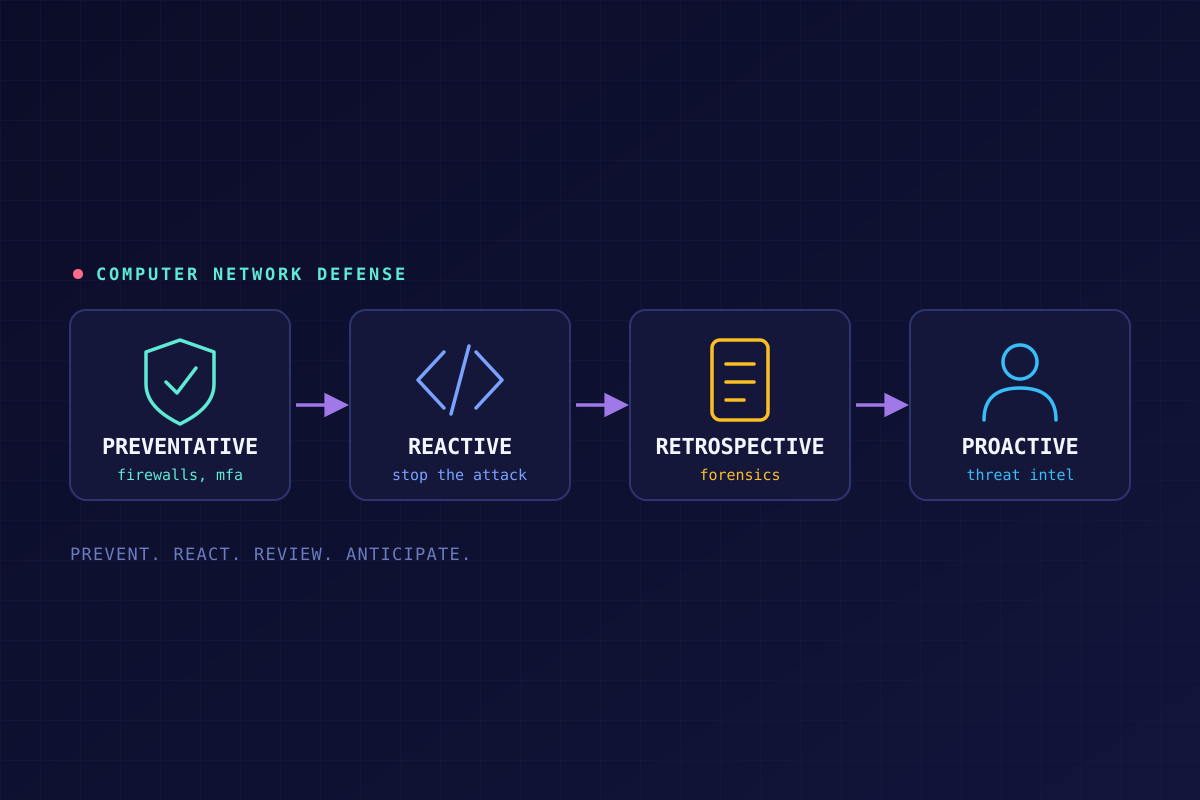
A mouthful, but it breaks down into four approaches that actually make sense once you see them laid out:
- Preventative — stop threats before they land. Firewalls and access controls, NAC/NAP, encryption like IPsec and TLS, biometric or multi-factor authentication.
- Reactive — handle what prevention didn't catch, like an active DoS or DDoS attack. Prevention and reaction aren't either/or. You need both.
- Retrospective — the after-the-fact work. Incident analysis, forensics, figuring out exactly what let the attack through in the first place.
- Proactive — using threat intel and risk assessment now so you're not caught flat-footed by the next one.
Why a Breach Is a Business Problem, Not Just a Network Problem
Here's the thing: a breach doesn't stay a technical problem. Stolen or corrupted data — customer records, patient data, intellectual property — tanks trust fast, and it can bring legal, civil, or regulatory consequences right along with it. If ransomware locks up critical files, or malware takes down core systems, production and sales can just stop.
And the costs stack. First there's the incident response itself — hiring people to negotiate a ransomware situation, say. Then there's the longer tail: lost business from reputational damage, legal fees, civil penalties. Employees lose productive time to downtime. Supply chains and logistics can cascade into their own mess. And every hour spent cleaning up is an hour not spent actually growing the business.
For a big company, that's a rough quarter. For a small business running close to the bone, it can be the whole business. Not because of some specific stat — I almost cited one here, but it turned out to be fabricated and got retracted by the org that supposedly published it, so I'm leaving it out — but because the same fixed recovery costs land on a lot less revenue to absorb them.
The Takeaway
CND isn't just government-speak for "network security." The four-part structure — prevent, react, review, anticipate — is honestly a decent way to audit your own setup, because most programs are heavy on prevention and pretty thin on the other three.
Sources
- National Institute of Standards and Technology. Computer Network Defense. NIST Computer Security Resource Center Glossary.
- U.S. Department of Defense. DoD Instruction 8500.01, Cybersecurity.