

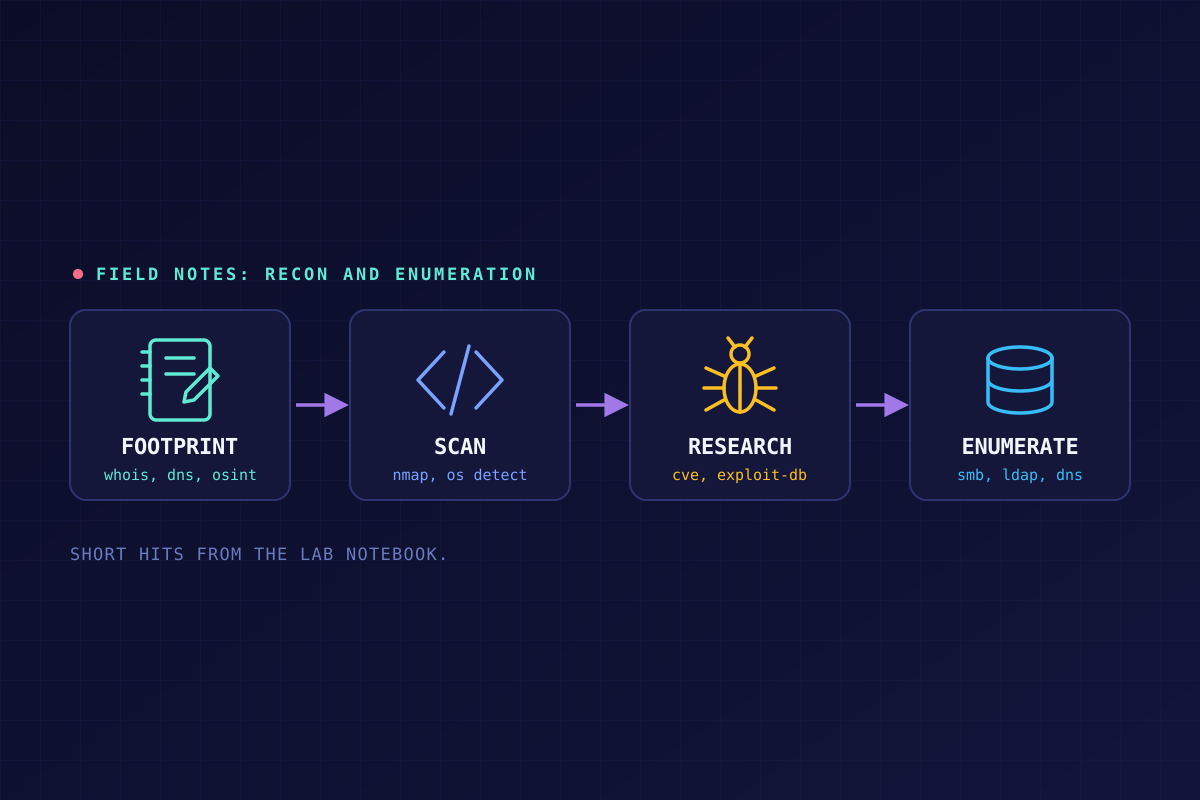
Field Notes: Starting Recon with a Whois Lookup
Before you scan a single port, a whois lookup can tell you who owns a domain, when it was registered, and sometimes a lot more than the owner intended.
If you're starting a penetration test or just footprinting a target, a whois lookup is one of the first, lowest-effort moves available. It's recon before recon: a quick way to build an initial picture of a domain before touching the network at all.
A few places to run one:
And a couple of command-line tools that go further than a plain whois lookup:
A site lookup is as simple as typing in the domain. DNSRecon is a DNS enumeration tool rather than a whois client exactly, but it's part of the same early-recon toolkit — a command like dnsrecon -d example.com -t std will pull standard DNS records (A, MX, NS, TXT, and more) alongside whatever whois data is available, which is why the two get used together.
What you're looking for in the results:
- Registrant name, organization, email, and phone number. If the registrant's email matches the organization's internal naming convention, that's a free sample for building out a phishing list or a credential-stuffing attempt.
- Domain age and expiration date. A domain close to expiring is a target for takeover — let it lapse, buy it, and stand up a spoofed site on a domain the organization used to control.
- Nameservers, which hint at the DNS setup and hosting provider.
- Ownership and contact history.
None of this is guaranteed. Whois privacy services redact a lot of this by default now, and a well-run organization won't have much here to find. But a whois lookup costs almost nothing to run, and even a partial result — a nameserver, an expiration date, a hosting provider — is worth having before the next step.
The Takeaway
A whois lookup won't get you into anything. What it does is cheap: thirty seconds for a result that might save you an hour of guessing later. That's the whole case for doing it first.