

Cyber Incident Ethical Response Plan
The fastest way to stop a breach can also be the fastest way to hurt the people you're trying to protect.
Simulated scenario. This post describes a hypothetical breach at an unnamed, fictional corporation. No real organization or incident is depicted. I wrote it as a response-plan assignment for a class. The sources cited are real.
Cybercrime is one of the most persistent threats to modern organizations. Businesses that are trusted with sensitive information like financial and personal data are the ones most often targeted by threat actors. The consequences of a sophisticated cyberattack or intrusion can extend far beyond financial losses. When such incidents occur, it can often undermine trust and damage a corporation or organization's public image and reputation. This response plan intends to address a hypothetical scenario in which such an attack has been suffered by a large corporation, compromising sensitive customer data. As the head of the incident response team, my duty is to prepare a comprehensive response plan that mitigates the impact of the breach while adhering to ethical principles. The importance of ethics in cybersecurity cannot be overstated. Transparency, accountability, and fairness must guide the actions of the response team to maintain (or rebuild) trust and prevent future incidents. The following plan aims to outline steps for immediate response, stakeholder communication, incident investigation, risk mitigation, and strategies to learn from mistakes so that future incidents are less likely.
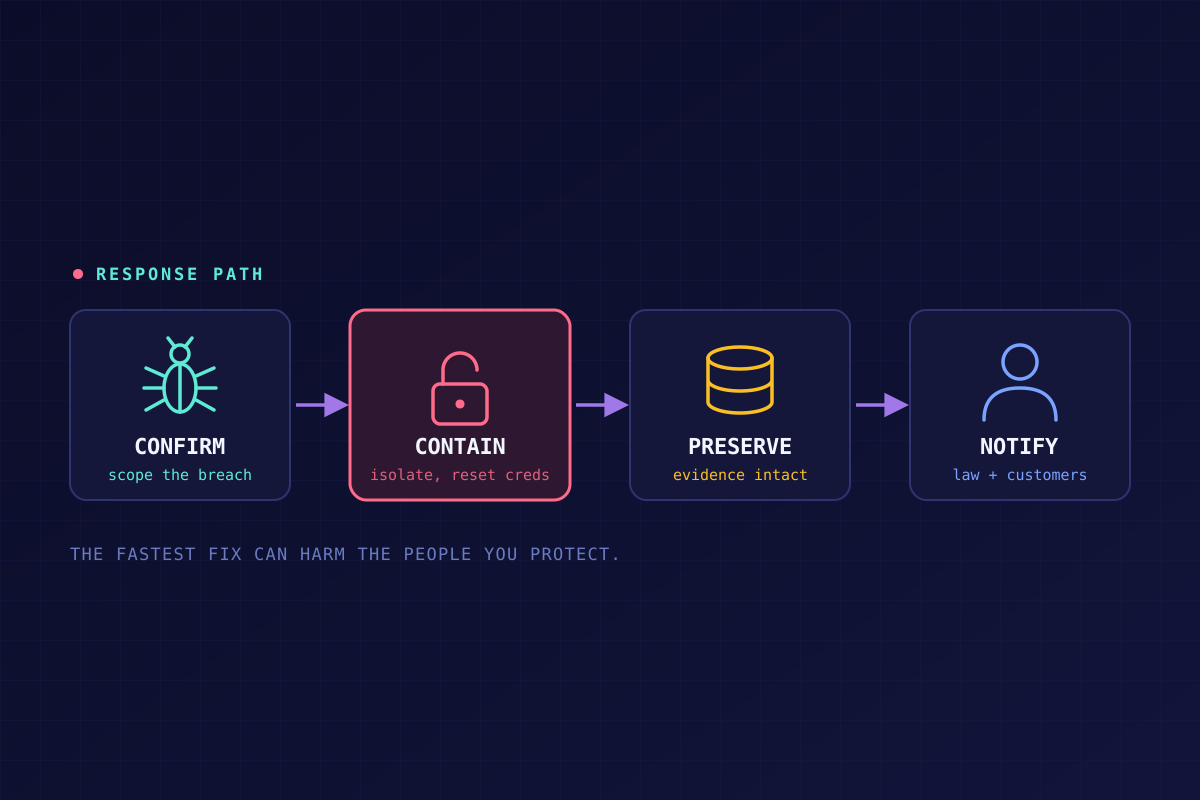
Confirm the Breach and Assess the Scope
In the first moments after the discovery of a cyberattack, every action becomes critical, and the need for effective and ethical decision-making could never be higher. Every decision could positively or negatively affect the outcome of the incident. The top priority is to confirm the breach and assess the scope. This process should involve log analysis including server and network logs, continual monitoring of network activity and the use of intrusion detection tools to spot anomalies. Working with the IT and cyber security teams, I will determine the specific areas affected, the type and scope of compromised data, as well as the potential vector of the attack.
Contain the Damage, Preserve the Evidence
Once the breach is confirmed, efforts must be made to contain the damage. Isolating compromised systems or subnetworks will be necessary to slow or prevent further data loss or movement of the threat actor within the corporate network. Actions like blocking suspicious IP addresses, disabling accounts, and implementing temporary restrictive firewall rules may be necessary. It is also advisable to trigger automatic password updates for all users and to lock down access controls or disable all group access to sensitive data immediately. One caution here: the FTC advises taking affected equipment offline but not powering machines down until forensic experts arrive, because shutting a system off can destroy volatile evidence, like what's sitting in memory. Obviously, this could be disruptive to operations; however, at the moment, a cost-benefit analysis must be done to weigh the potential harm of disruptions against the potential impact of further data loss.
Once the breach is confined, ethical efforts to preserve evidence for investigation become a priority. Such procedures should include securing logs, identifying and obtaining a sample of any malicious code, the identification and documentation of specific exploitation techniques, and the general preservation of data integrity for forensic analysis. Also, transparency between teams during the preservation stage will ensure that staff understand the mission and have confidence in the response process. When integrity is maintained throughout the preservation and handling of evidence, it is easier to collaborate with law enforcement and aid in the investigation as needed.
Of course, ethical considerations are engrained in every step of this phase. Containment must balance the need to defend against the attack while respecting the rights and privacy of employees and customers. Additionally, no unnecessary strains should be placed on employees or the business, and each action should be significantly weighed against ethical principles. For example, if shutting off all employee and customer access means that customers may not have access to banking funds for a period, this action must be weighed against the potential harm that could be caused by further intrusion. Individuals who are charged with making such determinations must make them in an ethical manner, with the aim of preventing the worst outcome.
Notify the Right People
It goes without saying that whenever a criminal breach has occurred, law enforcement should be notified, as well as other affected businesses and individuals. Legal and ethical requirements should guide the notification process. All applicable federal, state and local laws regarding notification of security and information breaches should be followed. Special attention should be paid to applicable laws when there are additional reporting requirements due to sensitive information. For example, if the breach involves electronic personal health records, and your organization is covered by the Health Breach Notification Rule, you must notify the FTC and, in some cases, the media. Organizations covered by HIPAA face a parallel requirement to notify the Department of Health and Human Services and, in some cases, the media. On the law enforcement side, the FTC advises calling the local police right away and, if they aren't familiar with investigating information compromises, contacting the local FBI or U.S. Secret Service office. Failure to comply in a timely and transparent manner with breach disclosure laws and regulations is also an ethical failure. In the absence of legal guidance or laws, organizations should take it upon themselves to prioritize an ethical approach to breach notification and ensure due diligence has been taken to ethically notify affected individuals and organizations in a timely manner.
Investigate and Learn
After the initial breach response and notification there should be a deeper investigative and mitigation project. During this period extensive log collection and analysis should be undertaken. Additionally, there should be an investigation into the tactics, techniques and procedures used to breach and navigate through the network. Interviews of staff may be conducted and a logbook kept as part of a fact-finding investigation. Once all of this is collated, it should be developed into a breach retrospective including lessons learned, mitigation steps taken, and preventative strategies. Any investigations should be undertaken responsibly and ethically, taking care not to falsely accuse employees without evidence, avoid bias, and act with the general aim of enhancing security instead of finding fault. Accountability must be a part of the process, but it should not be the focus of it. Such a course could invite unethical targeting and fail to actually address security concerns in a meaningful way.
Takeaway
Notice that nothing in this plan is a separate "ethics step." The ethical questions show up inside the technical ones: who loses access, who gets told, who gets blamed. That's the point of the exercise.
The above plan highlights the significance of integrating ethical considerations into the cybersecurity incident response process. From the initial stages to the after-action reporting, the ethical focus should remain on transparency, accountability and minimizing harm to stakeholders. The need for ethical decision-making is not only a moral imperative, but also a practical necessity for operating in an efficient and trusted way. When organizations place a high priority on such principles, they are better equipped to navigate the challenges of a cybersecurity incident while also maintaining their commitment and responsibility to stakeholders and the public at large.
Sources
- Dickerson, Robin. January 17, 2005. Incident Management 101: Preparation and Initial Response (aka Identification). SANS Institute.
- Federal Trade Commission. Data Breach Response: A Guide for Business. FTC.
- National Institute of Standards and Technology. February 26, 2024. The NIST Cybersecurity Framework (CSF) 2.0. NIST CSWP 29.