Anatomy of a Preventable Breach: How a Vendor's VPN Credentials Exposed 8,000 Customer Records
The following is a hypothetical breach scenario, generated to reflect realistic patterns seen in real-world incidents. This writer was given limited information relative to the scenario, and challenged to provide recommendations as a tabletop exercise. Names, companies, and details are fictional, but the mistakes are common ones.
Introduction
Yesterday, NanoWidgets, a B2B customer of XYZ Corp, reached out to their sales contact and flagged a suspicious email, one referencing the exact purchase order number and details of an order placed that same week. Their IT department had already flagged it as a phishing attempt. After reviewing the email, XYZ Corp's team grew concerned: the level of detail suggested a serious breach, not a coincidence.
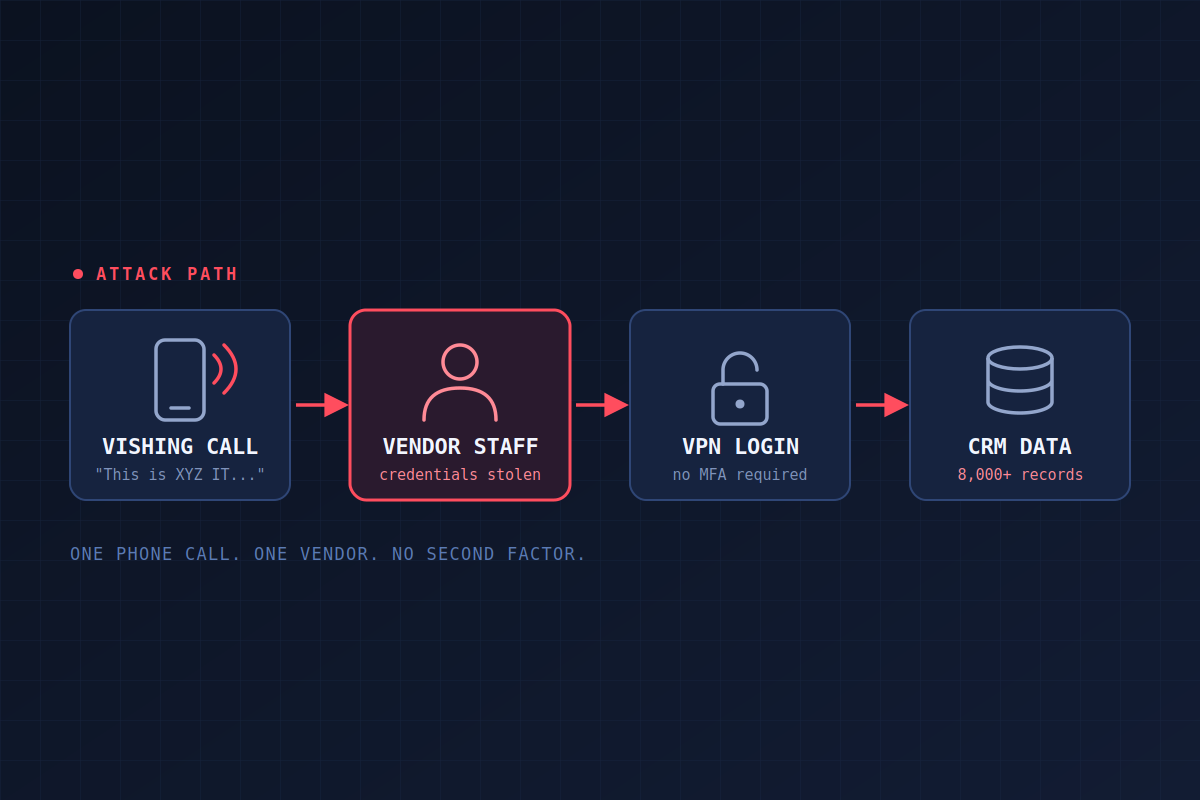
An audit of access logs was immediately performed across the network, revealing a suspicious pattern of overnight logins to XYZ Corp's on-premises CRM platform. These logins traced back to a VPN account provisioned for BrightPath Marketing, a third-party contractor hired to run email marketing campaigns and customer analysis. Further investigation revealed that three weeks earlier, a BrightPath employee had received a vishing call, a caller posing as XYZ Corp IT support, and had been socially engineered into handing over VPN credentials. The access logs lined up with that timeline, and CRM records confirmed that over 8,000 customer records had been exposed: names, emails, phone numbers, addresses, partial payment information, purchase history, and hashed portal passwords.
Security Environment
XYZ Corp is a mid-sized business running a lean IT team of 4-6 people, responsible for infrastructure, administration, and security, with no dedicated security function. As is often the case in organizations like this, security was reactive rather than intentional. There was no MFA on VPN access, no regular review of vendor access or least-privilege auditing, and network segmentation was minimal. The CRM and SQL infrastructure were behind on patching. Logging existed only for VPN and CRM systems, with no centralized detection or SIEM. Security awareness training for employees was minimal, and nonexistent for third parties with system access. Crucially, there was no callback or verification protocol for IT-initiated calls to employees or vendors, the exact gap the attacker exploited.
Immediate Response and Countermeasures
The priority in a scenario like this is to stop the bleeding first, then shift to prevention. In order:
- Temporarily disable the VPN service until individual accounts with MFA replace the shared vendor account.
- Audit all systems on the VPN/CRM subnet for malicious code or backdoors left for persistent access.
- Restrict VPN access to expected geographic regions (e.g., block logins from outside the U.S.).
- Stand up a SIEM solution (e.g., Wazuh) to centralize log collection and automate alerting.
- Conduct a full access audit to scope VPN/CRM permissions down to least-privilege for third parties.
- Roll out security awareness training, covering phishing and social engineering resistance, for internal staff and vendor personnel with system access.
- Establish a formal verification protocol (callback numbers, ticket verification) for any IT-initiated contact with employees or vendors.
- Hire a security analyst and engineer to own SIEM monitoring, alert response, training, and daily VPN log review.
Business Impact
XYZ Corp now has to notify thousands of customers of a breach, with a real risk that some of them become secondary phishing targets using the leaked data. Reputational and financial damage is close to unavoidable at this point. What makes this case notable isn't sophistication: there was no zero-day and no advanced malware chain. It was a single social engineering call against a third party, landing on an environment with no MFA, no vendor oversight, and no monitoring to catch it. Almost every recommended fix here is low-cost. The expensive part was not having them in place beforehand.
Why This One Matters: Vendor Access Is Your Attack Surface Too
The detail worth sitting with is that XYZ Corp wasn't breached directly; a marketing vendor was. Most companies pour resources into training their own employees to spot phishing, but treat third-party contractors as a black box: provisioned, forgotten, rarely audited. Attackers know this. A vendor's VPN account is often less protected and less monitored than an internal one, while granting comparable access to sensitive systems.
If there's one takeaway to borrow from this scenario, it's this: your vendor risk management should include the same baseline controls you'd require internally (MFA, least-privilege scoping, and verification protocols for support calls), because from the CRM's perspective, a compromised vendor credential is an internal breach.
~ Madnote